
Canada is in the middle of a once-in-a-generation energy transformation. As transportation, industry, and heating become increasingly electrified, our country is making long-term decisions about power systems that will shape affordability, reliability, and emissions for decades.
These decisions are complex. They involve billions of dollars in infrastructure investment, multiple levels of government, and an electricity system that must remain stable even as it changes rapidly. Yet much of the public debate about clean energy still relies on surprisingly simple math.
When new energy projects are announced, headlines often focus on one number: cost per unit of electricity. Technologies are compared based on how cheap they appear on paper, and those comparisons quickly become shorthand for what is “affordable” and what is not.
But electricity systems are not built on paper.
They are built to deliver power when people actually need it, to remain stable during extreme weather, and to operate reliably for generations. And those realities are not captured by the simplified cost metrics that dominate public discussion.
WaterPower Canada recently released a new report, The True Value of Hydropower, which examines how simplified cost metrics can obscure the long-term value of reliable, durable electricity infrastructure.
Cheapest energy isn’t cheapest system
The most commonly used metric in energy comparisons is the Levelized Cost of Energy, or LCOE. It measures how much it costs to produce a unit of electricity from a specific project.
LCOE is useful for some purposes. It can help compare similar projects under similar conditions. But it was never designed to answer a much more important question: how well does an electricity system perform over time and deliver enduring value to the grid?
It is important to note that system operators and utilities already use sophisticated planning models that account for reliability, capacity, and long-term system performance. The issue is not how electricity systems are actually planned, but how energy costs are often discussed in public policy, regulatory frameworks, and public debate, where simplified metrics like LCOE are frequently used as stand-ins for system value.
Electricity is not like most commodities. It must be produced exactly when it is needed. It cannot be easily stored at scale. And the infrastructure that delivers it must remain functional for decades.
Some resources can reliably meet those needs. Others cannot. Yet traditional cost comparisons used by policy makers sometimes treat all electricity as interchangeable — regardless of how it is deployed, how long the infrastructure lasts, or what value remains at the end of its life.
This creates a distorted picture of what is truly affordable, and what is not.
We plan in decades. Assets last a century.
One of the most overlooked factors in energy planning is asset lifespan.
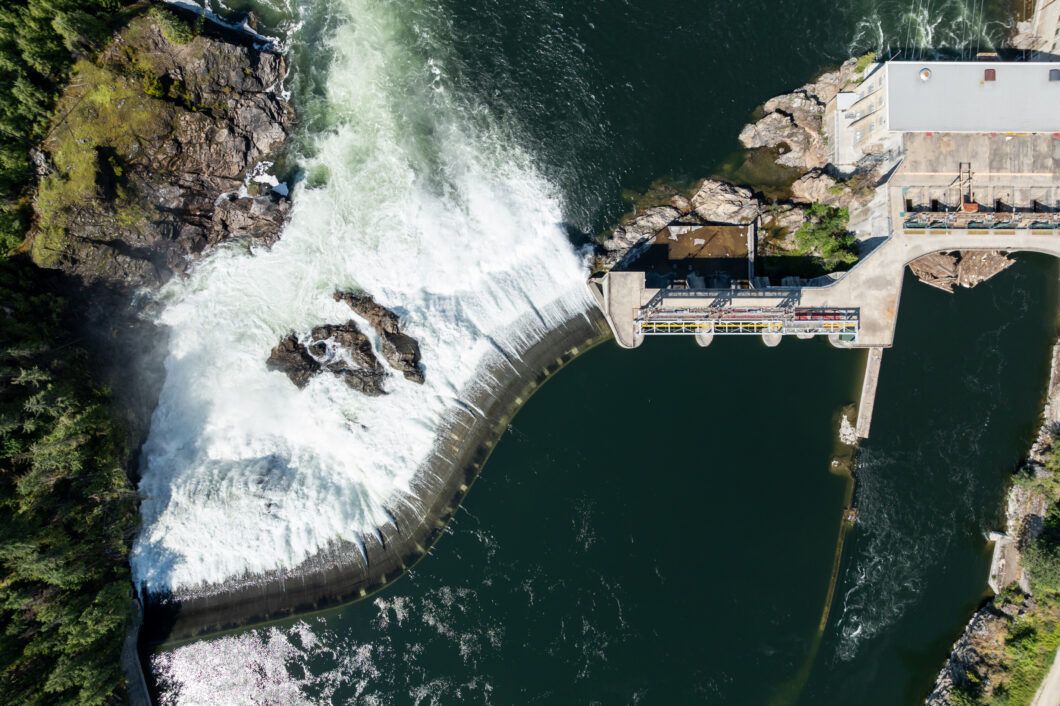
Hydropower facilities commonly operate for 80 to 100 years or more. Many of Canada’s largest generating stations were built in the early 20th century and are still operating today, providing dependable electricity to millions of Canadians.
By contrast, most wind and solar facilities operate for 20 to 30 years. Over the lifespan of a single hydropower facility, they must be rebuilt three or four times to provide the same long-term service. Those future rebuilds represent real costs. They involve new construction, new materials, new labour, and new capital. Yet many headline cost comparisons focus on upfront project costs rather than the full reinvestment cycle required over time.
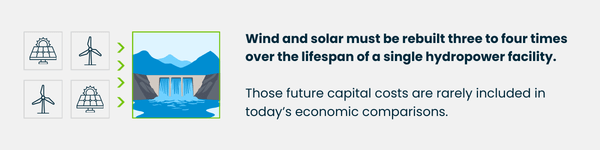
What looks inexpensive in the short term can become far more costly when viewed across decades. In other words, some projects appear inexpensive on paper because their full lifetime and system costs are not included in the evaluation.
Reliability is not optional
Another missing piece in many clean energy discussions is reliability. Electricity systems must function during peak demand, not just on average. They must remain stable during heat waves, cold snaps, and extreme weather events. And they must be able to respond when other resources are unavailable.
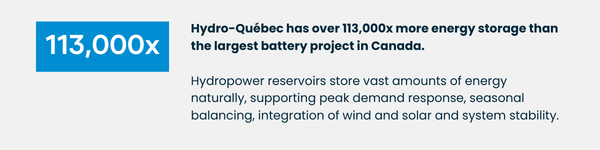
Hydropower plays a unique role here. Large reservoirs store enormous amounts of energy, providing flexibility that no other clean technology can match. For example, Hydro-Québec alone has more than 113,000 times the energy storage capacity of the largest battery project in Canada.
That storage enables peak demand response, seasonal balancing, and the integration of other clean energy resources. It allows wind and solar to scale without compromising system stability. It acts as a natural buffer in a system that must constantly balance supply and demand.
This is not a marginal benefit. It is foundational infrastructure.
The hidden cost of short-term thinking
When reliability and long-term asset value are ignored, important system realities get pushed aside. Short-lived assets require repeated investment. Intermittent resources require more backup capacity. And increasingly complex systems require more infrastructure to keep them stable.
Each of these requirements carries a cost: in construction, in maintenance, and in system complexity. And over time, those costs accumulate. They show up in electricity bills, public spending, and in the difficulty of maintaining reliable service.
This is not a debate about which technology is better than another. It is about whether the tools being used to guide critical infrastructure actually reflect how electricity systems operate in the real world.
Planning based on simplified metrics can lead to decisions that look cost-effective today, but prove expensive and inefficient over decades.
Hydropower as foundational infrastructure
Hydropower is often described as capital-intensive, and that is true at the project level. Large dams and generating stations require significant upfront investment.
But over time, hydropower delivers unmatched reliability, long asset life, and system flexibility. It continues to generate electricity long after many other assets would have been replaced. It provides storage and capacity that support the entire system, not just a single project, and is not subject to fuel price volatility over time.
This is the system value that does not show up in simplified cost comparisons, but is essential to maintaining a stable and affordable electricity grid. In many ways, hydropower is less like a single technology and more like infrastructure. It is closer to transmission lines or reservoirs than to individual generation projects. It underpins the system rather than competing within it.
A different way of thinking
Canada does not need to abandon existing cost tools. But it does need to use them alongside other types of analysis that take into account the factors that these models do not consider.
Planning a clean energy future requires moving beyond simple project-level comparisons and toward a system-wide understanding of value. That means considering not just how cheap something looks today, but how it performs over decades.
It means asking harder questions about reliability, durability, and long-term system costs. And it means recognizing that affordability is not just about upfront price, it is about what Canadians will pay, and depend on, over the next 50 to 100 years.
Using better planning tools is essential to building a clean energy system that is affordable, reliable, and resilient for Canadians.