

Guest blog by Dr. Andre Erler, Senior Climate Scientist, Aquanty Inc.
 Canada is one of the world’s leading producers of hydroelectric power, with more than 60% of its electricity generated from water. Hydroelectricity has long been a cornerstone of the country’s clean energy strategy, offering a renewable and low-carbon source of power that supports both economic growth and climate commitments. Yet, the accelerating impacts of climate change are reshaping the hydrologic systems that make hydropower possible. Declining mountain snowpack, prolonged drought across parts of the Prairies, shifting seasonal runoff patterns, and more frequent extreme rainfall events in regions across the country are changing when and where water is available. These changes are contributing to reduced inflow reliability across many Canadian watersheds, making it more difficult for operators to predict how much water will be available when it is needed most.
For hydroelectric operators, these shifts introduce uncertainty in both daily operations and long-term planning. A central challenge is confidence. If a utility is designing or upgrading a hydroelectric facility today— an asset expected to last 50 to 100 years— can it rely on historical hydrologic patterns to forecast future energy production and ensure financial viability over the asset’s lifetime? These changes can mean reduced generation capacity in dry years, heightened flood management pressures in wet years, and greater complexity in balancing power production with ecological and community water needs. Historical hydrology is no longer sufficient. Climate change is altering Canada’s water cycle in unprecedented ways, requiring tools that do not rely solely on the past, but account for the physics of a future warming climate. To remain resilient, operators require forward-looking insights that go beyond historical data; and this is where advanced modelling approaches can play a critical role.
From historical data to future-ready planning
By applying advanced, physics-based hydrologic models, Aquanty delivers tailored climate change impact analyses that give Canadian dam operators the foresight to plan, adapt, and thrive in the face of uncertainty.
Rather than extrapolating from the past, HydroGeoSphere allows operators to plan using projections rooted in physical reality— supporting informed decisions around reservoir design, generating capacity, licensing, infrastructure upgrades, and long-term resource planning. HydroGeoSphere is recognized globally as one of the world’s leading integrated hydrologic modeling platforms, with two decades of scientific validation and deployment across complex cold-region and mountainous environments typical of Canadian hydroelectric systems.
Yet, while long-term planning requires robust hydrologic simulations, short- and medium-term operations depend on near-real-time forecasting. Every day, reservoir managers must decide how much water to store and when to release it— balancing the need to maintain generation capacity, reduce spill risk, avoid flooding, protect downstream communities, and sustain ecological flows. These decisions rely heavily on accurate weather and streamflow forecasts, which must reflect rapidly changing hydrologic conditions.
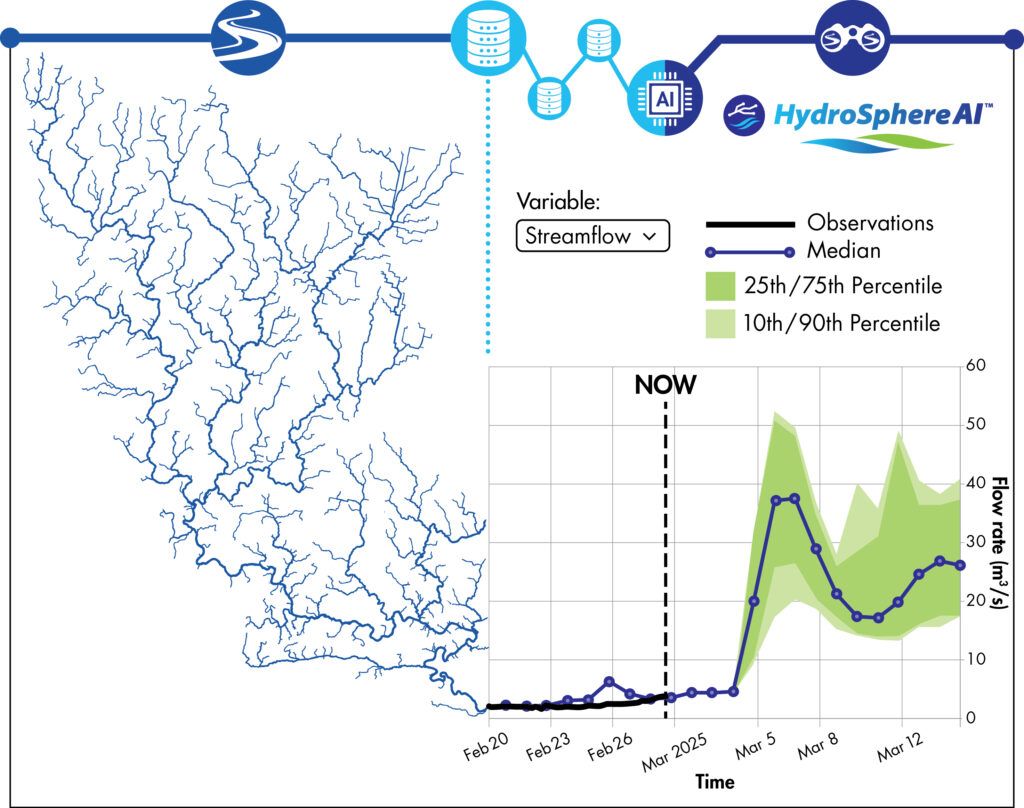
To support these operational needs, Aquanty developed HydroSphereAI, a machine learning–based streamflow forecasting system that integrates real-time climate data, watershed conditions, and learned physics of runoff generation to provide highly accurate forecasts days to weeks ahead. This forecasting capability can support more informed operational decision-making, including aligning generation with market conditions and managing high-flow risks. HydroSphereAI strengthens operational confidence by improving reservoir decision-making at the time scale when responsiveness matters most. In recognition of its impact, HydroSphereAI was recently awarded the 2025 Water Canada New Tech Award, recognizing it as one of the country’s most impactful advancements in data-driven, climate-resilient hydrologic forecasting and water management solutions.
From reactive to proactive water management
Together, HydroGeoSphere and HydroSphereAI offer a complementary toolkit for Canadian hydroelectric companies. HydroGeoSphere provides the long-term watershed foresight needed for strategic planning and climate adaptation. HydroSphereAI provides real-time intelligence to optimize daily operations and manage risk as conditions change. This dual capability enables hydro operators to move from reactive management to proactive, climate-resilient decision-making.
More broadly, these kinds of modelling and forecasting tools support many of the priorities shaping the future of Canadian hydropower — from strengthening energy security and system reliability, to enabling climate adaptation, supporting Indigenous and community water stewardship, and ensuring infrastructure investments remain resilient over the long term.
Hydroelectricity in Canada is more than a clean power source— it is deeply tied to water security, environmental stewardship, fisheries protection, Indigenous water rights, and community safety. As climate change continues to reshape Canada’s hydrologic systems, the need for science-driven planning and forecasting has never been more critical. With physics-based watershed modeling and award-winning operational forecasting, Aquanty equips hydro operators with the tools to navigate uncertainty with confidence, ensuring reliable electricity generation today while planning responsibly for the decades ahead.
This is a guest contribution. Views expressed are those of the author and do not necessarily reflect the views of WaterPower Canada.
Author Bio
 Dr. Erler is a Senior Climate Scientist at Aquanty Inc. Andre has performed high resolution climate simulations and studied hydrological impacts of climate change on river basins across Canada, and changes in precipitation extremes due to climate change. Andre joined Aquanty in 2016 to study the impact of climate change on water resources in Canada and provide insights into climate change impacts to end-users. He is also the project lead for HydroSphereAI – a machine-learning algorithm for streamflow forecasting.