
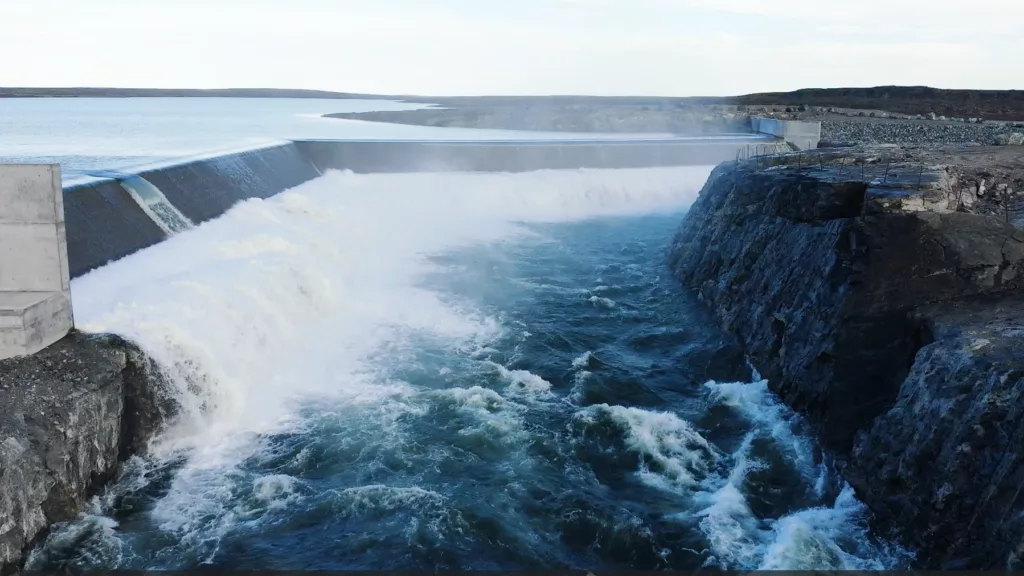
The Innavik Hydroelectric Project, developed by Innergex in partnership with the Inukjuak community, is a run-of-river facility that helps reduce reliance on diesel and supports a cleaner, more resilient energy future in northern Québec. Photo: Innergex Renewable Energy Inc.
Canada’s climate ambitions rest on a simple premise: electrify everything and do it quickly. Transportation, heating, and industry must all shift away from fossil fuels, and that shift depends on two things: demand for electrification and an electricity system that can grow fast enough, clean enough, and reliably enough to support it.
If Canada is serious about electrification, that system must be built accordingly. Right now, it is not.
Electrification is central to Canada’s climate goals
The problem isn’t a lack of clean energy options. Canada has water, wind, solar, innovation, and capital. The problem is that the country is trying to decarbonize its electricity system while constraining, and often sidelining, the very resources that make deep decarbonization possible. Chief among them is waterpower.
Waterpower underpins a clean and reliable grid
Waterpower plays a role in Canada’s electricity system that no other clean resource can fully replace. Beyond being non-emitting, it provides power when it is needed, not just when conditions are favourable. Reservoirs and pumped storage allow electricity to be stored and released during peak demand, extreme weather, drought, or prolonged calm periods, exactly when wind and solar output can fall short.
As electrification accelerates, electricity demand becomes more sensitive to temperature and weather. Cold winter mornings, summer heat waves, and prolonged extreme events place the greatest strain on the grid, and those stresses are becoming more frequent, not less.
Focusing on weather-dependent generation, without enough dependable backup, creates a more fragile system as demand grows. Electrification amplifies this risk by increasing reliance on electricity at the same time that supply becomes more variable. Reliability failures quickly become economic and social failures, eroding public confidence in the transition itself.
Waterpower directly addresses that challenge. Yet Canada is failing to fully unlock its potential.
And here is the elephant in the room that rarely enters the conversation: only one-fifth of Canada’s energy supply comes from renewables.
Of that renewable share, 87 per cent comes from waterpower. Wind accounts for just over 11 per cent. Solar contributes about 1 per cent, according to Statistics Canada (2024).
And yet, much of the public debate about Canada’s climate future is framed as if scaling wind and solar alone will be sufficient. In reality, a reliable electricity system cannot be built on variable generation alone. This is not a question of choosing between resources, but of building a system that performs under all conditions.
This fact does not diminish the importance of wind and solar. They are essential to the transition and must grow substantially. But the numbers reveal an inconvenient truth: the clean energy system Canadians rely on today is overwhelmingly built on waterpower, not as a backup, but as the foundation that enables variable renewables to scale reliably. Ignoring that reality doesn’t make the transition more ambitious, it makes it less grounded in how the system actually works.
Climate ambition must align with system reality
Canada’s climate plans increasingly assume a future grid dominated by wind and solar, supported by technologies still emerging or not yet deployed at scale. Meanwhile, the resource that already provides reliability, storage, and flexibility is often treated as yesterday’s technology—useful, but not central to tomorrow’s plans.
This creates a practical problem. There is substantial opportunity to expand clean electricity supply through upgrades to existing hydroelectric facilities and pumped storage development, often at sites where infrastructure already exists. These projects use proven technology, carry lower development risk than greenfield generation, and strengthen the grid that variable renewables depend on.
Yet many remain stalled, not primarily due to technical or safety concerns, but because approval processes have become counterproductive. To be clear: environmental assessment, Indigenous consultation, and ecological protection are legitimate and necessary. This must be done while upholding strong environmental standards and advancing meaningful Indigenous partnerships. The problem is not that these processes exist, but that they have become so slow, fragmented, and unpredictable that even low-impact projects face years of regulatory uncertainty.
Upgrading an existing facility can trigger the same lengthy federal review as building a new dam. Routine works that have a minor impact on the surrounding ecosystem require the same amount of paperwork as major works. Pumped storage projects that reuse existing reservoirs encounter approval timelines that assume far greater environmental disruption than actually occurs. Promised reforms to streamline assessment for climate-enabling infrastructure have been discussed since 2019. Actual implementation remains limited.
The result is a quiet contradiction: governments set ambitious electrification targets while maintaining regulatory systems that delay the very infrastructure those targets require. Physics doesn’t negotiate. When dependable clean power cannot be built on realistic timelines, something else fills the gap, usually fossil-fuelled generation during high-demand periods. This undermines emissions goals, increases costs, and creates exactly the reliability risks that erode public confidence in the transition.
This matters beyond the electricity sector: industrial competitiveness, housing electrification, and EV adoption all depend on affordable, reliable clean power arriving faster than current timelines allow.
Building the system Canada’s climate goals require
The answer is not to weaken climate targets or slow the growth of wind and solar. Nor is it to hope that emerging technologies will arrive in time, at scale, to solve the problem on their own. The answer is to start from the system Canada already has and strengthen the resources that already carry the load.
Waterpower is not a silver bullet. But without it, Canada’s electricity transition becomes slower, riskier, and more expensive than it needs to be. With it, wind and solar can scale faster, fossil fuels can be phased out more reliably, and electrification can proceed without sacrificing affordability or stability.
Climate targets are ultimately constrained by physical systems. Announcing goals is easy; building the infrastructure to meet them is harder. If Canada wants its climate plans to succeed in the real world, not just on paper, waterpower can no longer be taken for granted.
Waterpower has powered Canada for more than a century. In the race to meet our climate goals, it may determine whether we succeed at all.